
Essential Tools Every Tiny Home Owner Should Have
Essential Tools Every Tiny Home Owner Should Have
Quick Answer: Each owner of a tiny home should have a small but reliable assortment of tools for carrying out basic repairs, for measuring, for tightening hardware, for cleaning up, and for carrying out regular checks. The aim is not to assemble a collection on the scale of a contractor's, but rather to keep the most useful tools within easy reach without giving up any of the valuable storage space.
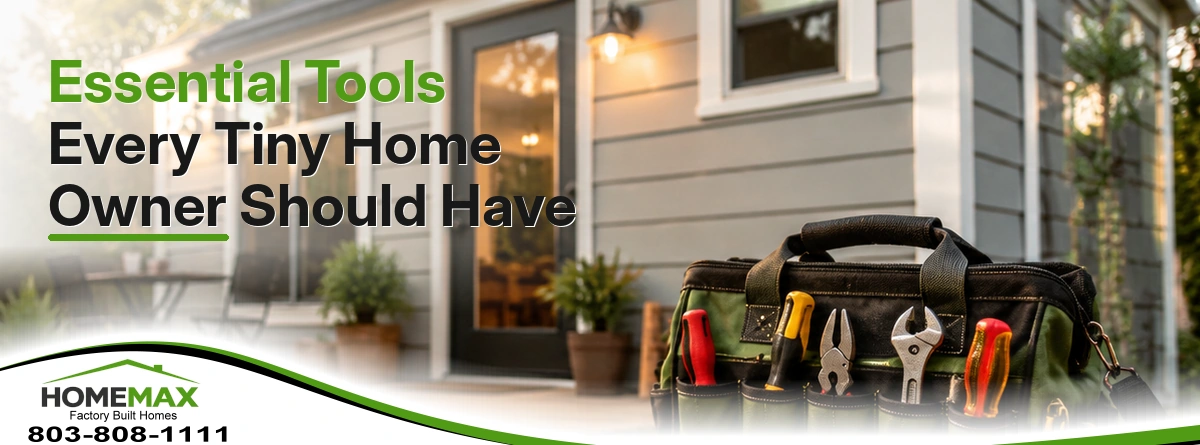
Essential tools are arranged next to a landscaped tiny home in South Carolina.
Tiny homes benefit from good organisation since a loose assortment of large tools can soon take over a cabinet. A thoughtfully planned kit, on the other hand, is able to cope with the majority of normal household tasks and at the same time can fit on a shelf, in a drawer, or in a small utility closet. When you are comparing factory-built tiny homes, you should also consider tool storage at the same time as you look at the kitchens, the closets, the utility access and the everyday living space.
Start With a Compact Everyday Tool Kit
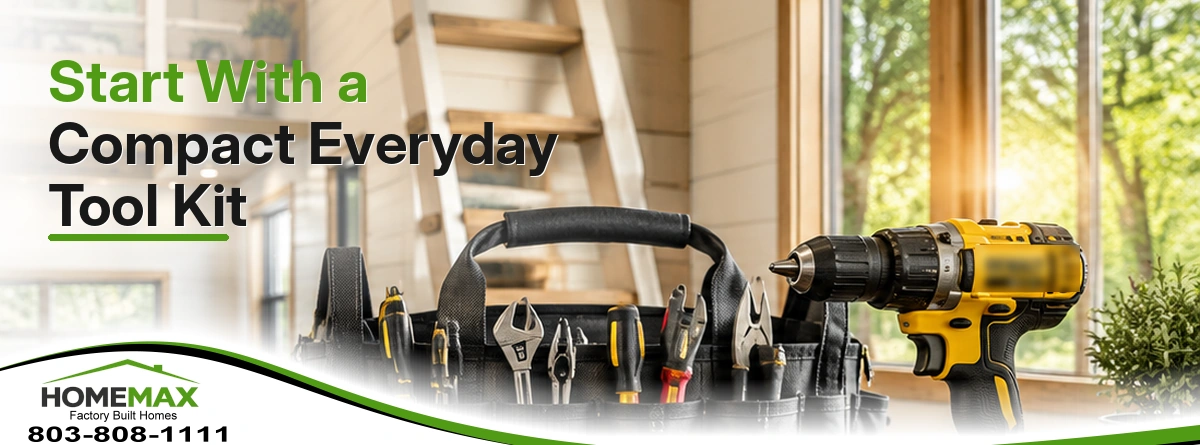
A starter kit that is practical should contain a ratcheting screwdriver together with a number of bits, an adjustable wrench, tongue-and-groove pliers, a claw hammer, a tape measure, a utility knife, hex keys, and a small socket set. It would also be useful to have a compact cordless drill or driver for use in hanging hardware, assembling furniture, and carrying out ordinary fastener work. The bits that match them, along with the chargers and the small accessories, should be kept together in order that the kit remains useful rather than turning into another collection of loose parts.
Tools for Quick Household Checks
A bright flashlight or headlamp, together with a small level and a stud finder and a basic moisture meter, can be of use when carrying out regular inspections. In South Carolina, where humidity and summer storms are a normal part of life, it is helpful to detect dampness near a window, at a plumbing connection or at an exterior opening as early as possible. Although a moisture meter can indicate a spot that needs to be looked at, it cannot diagnose the cause; electrical problems, ongoing leaks, and repairs that go beyond normal homeowner maintenance should be dealt with by a qualified professional.
Small Cleanup Tools That Matter
A small wet-and-dry vacuum, together with microfiber cloths, a soft brush, a small bucket and a hand broom, will soon take up its place. Although tiny homes have a smaller floor space, dust, dirt tracked in, and small bits of debris can still accumulate rapidly. Indeed, a small vacuum is particularly useful following drilling, when assembling furniture, or when cleaning the areas around entrances, the utility spaces and the storage compartments.
Choose Tools That Earn Their Storage Space
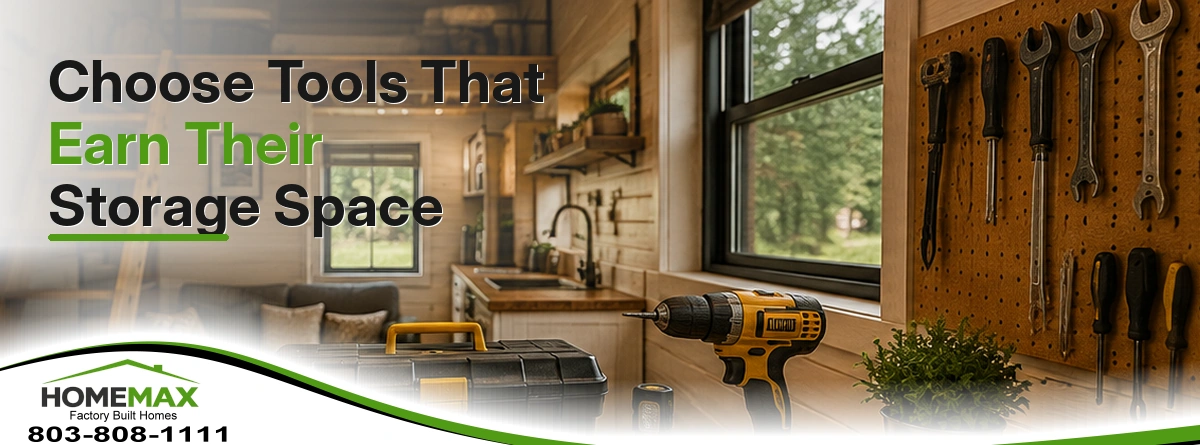
In a small house, the most useful tool is usually the one which can carry out several different tasks. Choose compact cases, folding handles, multi-bit drivers, and tool rolls which keep the equipment in order without using up space in the cabinet. Place heavier tools lower down so that the ones you use often are easy to reach and don't block off electrical panels, plumbing access or any other service areas. When the house is built to be moved, it is important to secure the tools before transporting them.
Why This Matters
A compact and well-organized tool kit makes it easier to carry out ordinary home care since you don't have to browse through the boxes in order to deal with a loose hinge, make a small adjustment to furniture, or carry out some simple maintenance. It also prevents you from having to buy tools again just because you can't find the one that you already have.
Common Mistakes
- To buy large specialty tools without first knowing whether they will actually be needed.
- Leaving loose sharp tools in drawers so that they cannot be stored safely.
- Using non-professional tools for electrical, plumbing, or structural work which qualified professionals should carry out.
Best Practices
- Start with one compact core kit, and add tools only when you really need them.
- Store batteries, drill bits, fasteners, and small accessories in labeled organizer boxes.
- Check the kit once or twice a year and remove any duplicate or damaged items.
Local Relevance
For people who own tiny homes in the areas around Lexington, Columbia, and the Midlands, the practical maintenance tools they use should be suitable both for the type of home and for the local climate. Since humidity, pollen, heavy rain and thunderstorms occur, flashlights, cleaning tools, work gloves and simple moisture checks become especially useful. However, the specific kit needed will still vary according to the home, its utility systems, the property and the kind of maintenance the owner is willing to carry out.
When to Contact HomeMax
If you're still deciding on a tiny home, you should consider the storage and service access before making your purchase. You'll be able to arrange a trip to see a model home in order to compare the different floor plans, cabinet space, utility areas, and other practical features that have an impact on daily living.
Final Thoughts
A tool kit for a tiny home that is suitable will be compact, well organised, and designed around the sorts of jobs you are most likely to carry out. Begin by taking the essential items, reserve space so that you can add only those things which turn out to be useful, and realise when a repair needs the assistance of a professional. For more practical information about buying a home, the HomeMax blog provides articles on manufactured homes, tiny homes, and on planning for people who buy in South Carolina.
Frequently Asked Questions
What tools should a homeowner of a tiny house have?
A basic set of tools should include a ratcheting screwdriver, an adjustable wrench, pliers, a hammer, a tape measure, a utility knife, hex keys, a small socket set, a flashlight, and a compact drill or driver if you use one.
Are power tools essential for a tiny home?
Not really. Many common tasks can be done with hand tools, though a small cordless drill or driver can be useful for assembling furniture, fitting hardware, and general fastening work.
How should tools be stored in a small house?
By using a compact case, a tool roll, a shallow cabinet, or a rack that attaches to the wall. Store heavier tools low, keep frequently used items within reach, and keep service panels clear.
Should plumbing tools be kept in a tiny home?
Basic pliers and an adjustable wrench can assist with simple tasks for homeowners. However, for active leaks, hidden plumbing problems, or repairs beyond ordinary maintenance, you need to call a qualified professional.
Are the small home maintenance tasks different in South Carolina?
The fundamental requirements are the same. That said, the humidity, pollen, heavy rain, and thunderstorms found in South Carolina make it especially useful to do moisture checks, clean your tools, wear work gloves, and have a reliable flashlight.